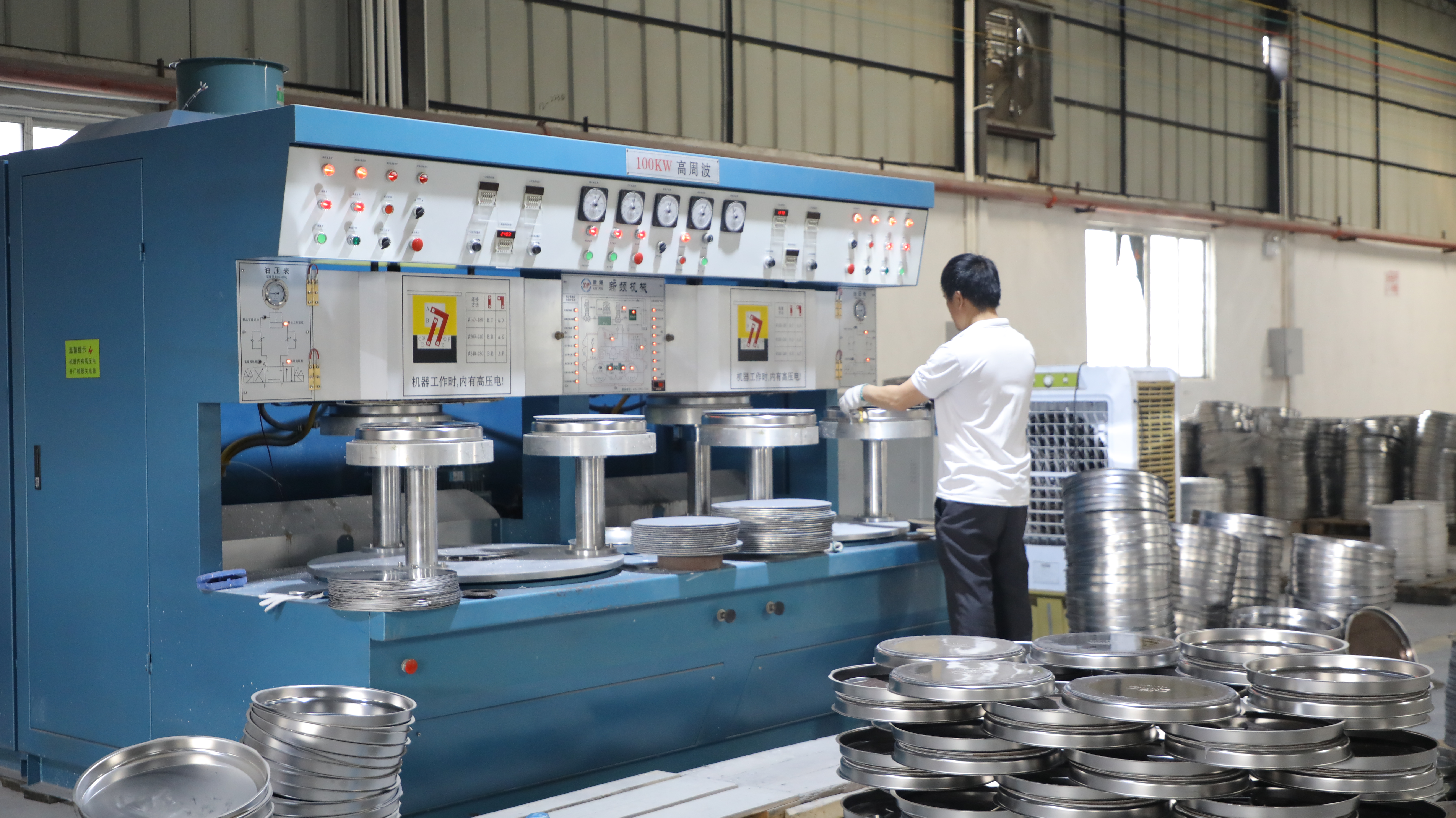
Quick answer: A custom cookware project runs through six stages — brief and feasibility, technical drawing, sampling, sample approval, tooling and mass production, then inspection and shipment. The two stages that decide whether the project succeeds are sampling and sample approval. Everything after that is execution. Budget four to eight weeks from brief to approved sample for a straightforward stock pot or sauce pot modification.
Buyers new to custom manufacturing often assume the hard part is the factory. In our experience the hard part is the brief. A project that starts with a clear, numerate specification moves quickly; one that starts with "something like this, but different" absorbs weeks in clarification before a drawing is ever issued.
Jiangmen Vanstar Kitchenware offers integrated design and production, and can customise products according to customer requirements and samples. Our production covers stock pots, sauce pots, three-layer steel pots, stainless steel dishes and self-service catering equipment. This guide sets out the sequence we follow, the decisions that belong at each stage, and the points where a project most often loses time.
In this article
- OEM and ODM: which one are you actually buying?
- Stage 1 — Brief and feasibility
- Stage 2 — Technical drawing
- Stage 3 — Sampling
- Stage 4 — Sample approval
- Stage 5 — Tooling and mass production
- Stage 6 — Inspection, packing and shipment
- Consolidated timeline
- The four approval gates worth enforcing
- Mistakes that cost the most time
- FAQ
OEM and ODM: which one are you actually buying?
The two terms are used interchangeably in quotations, but they describe different starting points and different cost structures. Getting the distinction right before the brief saves money.
| OEM | ODM | |
|---|---|---|
| Starting point | Your design or drawing | Our existing product, modified |
| Who owns the design | You, as a rule | The manufacturer, with modifications shared |
| Tooling cost | Usually higher, since tooling is specific to your design | Lower or nil where existing tooling can be adapted |
| Time to first sample | Longer — drawing and tooling come first | Shorter — starts from a physical reference |
| Best suited to | Programmes where the product is part of your brand differentiation | Programmes where speed to market and cost matter more than exclusivity |
| Minimum order implications | Typically higher, because tooling must be amortised | Typically lower, because tooling is shared or already paid for |
Most first projects are hybrids. A buyer takes an existing stock pot as the reference, then asks for a different diameter, a different lid, a different handle and a different surface finish. That is ODM with modification, and it is the most efficient way to start because it removes the risk of an unproven design while still delivering a product that matches your market.
Stage 1 — Brief and feasibility
The brief is a written specification, not a conversation. Its purpose is to let the factory tell you, before any money is committed, whether what you want can be made, at what cost, and at what minimum order quantity. A useful brief covers the following.
- Product type and reference — stock pot, sauce pot, composite-base pot, dish or catering equipment. If you have a physical reference or a competitor product, say so; a reference resolves more ambiguity than any description.
- Dimensions — diameter and height, in millimetres. Capacity in litres and US quarts as a cross-check.
- Material expectations — which grade you expect on the cooking surface, and whether the pot must work on induction.
- Thickness — body, lid, base and aluminium core, if you have a view. If you do not, say so and ask for a recommendation; a factory that manufactures both will usually propose the specification that fits your price point.
- Surface finish — sanded or polished, internal and external.
- Handles and fittings — type, fixing method, wire diameter if relevant.
- Packing — retail packaging or plain export cartons, units per carton, any labelling requirement.
- Destination market — this drives the documentation you will need. If you are exporting to the US or Europe, say so at the brief stage rather than after the sample is approved.
- Target volume and delivery window — a first order quantity and a required delivery date. Both shape the quotation more than most buyers expect.
Feasibility is a real stage, not a formality. The output you should expect is a written response covering: whether the specification is manufacturable, which elements need changing, the tooling position (new tooling or existing), the minimum order quantity, indicative unit pricing at two or three volume bands, and a lead time. If you receive only a price and a lead time, ask the remaining questions before proceeding.
Stage 2 — Technical drawing
Once the brief is agreed, it becomes a technical drawing. This is the document that controls the project. Everything downstream — sampling, inspection, dispute resolution — references the drawing, so it is worth reviewing carefully even if you are not an engineer.
A working drawing for a stainless pot should carry at minimum: overall diameter and height, capacity, thickness per component including the aluminium core where applicable, material per component, handle position and fixing, surface treatment, and tolerances. Where tolerances are unspecified, the factory will apply its normal production tolerance, and that tolerance may be looser than your market expects.
| Drawing element | Why it causes disputes when omitted |
|---|---|
| Thickness per component | A single overall thickness figure lets the factory redistribute material between body and base, changing both weight and performance. |
| Material per component | Without it, grade substitution between 201 and 304 is difficult to challenge later. |
| Aluminium core thickness | The performance-defining figure for composite bases. Omitting it removes the main quality lever. |
| Handle fixing method | Welded and riveted handles fail differently and are inspected differently. |
| Tolerances on diameter and height | Without stated tolerances, a pot a few millimetres off nominal is still "to specification". |
| Surface finish standard | Sanded finishes vary in grit and direction; without a reference, appearance will vary between batches. |
Ask for the drawing in a format you can mark up, and expect to go through two or three revisions. Revisions at this stage are cheap. Revisions after tooling are not.
Stage 3 — Sampling
Sampling produces a physical unit that you can hold, weigh, heat and inspect. This is where the specification stops being a document and becomes a product, and it is where most specification errors are caught.
Expect to discuss three related but distinct things before sampling starts:
| Item | What it covers | What to agree in advance |
|---|---|---|
| Sample charge | Cost of producing the sample, often including tooling if new tooling is required | Whether the charge is refundable against the first mass-production order |
| Sample lead time | Time from drawing approval to sample despatch | A date, not a duration, so it can be tracked |
| Sample quantity | Usually one or two units | Whether a second unit is needed for destructive testing without losing your reference piece |
When the sample arrives, test it against the drawing rather than against your impression of it. The checks below are the ones that most often reveal a deviation, and all of them are quick.
- Measure diameter, height and base thickness with a caliper at several points. Compare against the drawing figures, not against nominal expectations.
- Weigh the unit and compare against the quoted net weight. A significant shortfall usually indicates a thickness or grade deviation.
- Check the base on a flat surface for rocking, and tap it across the width to listen for a consistent note.
- Test induction compatibility with a magnet if the specification calls for it.
- Fill and lift to working capacity, using one handle only, to approximate worst-case handling.
- Inspect the finish for sharp edges, weld spatter and consistency of surface treatment.
- Cook with it if you can. A short simmer of a salted liquid will surface pitting problems on lower grades within hours rather than months.
Stage 4 — Sample approval
Sample approval is the point of no return. Once you approve, the sample becomes the reference standard, and mass production will be judged against it. Treat the approval as a formal step with a written record, not an email saying it looks fine.
Keep a retained sample. Approve against a signed specification and retain the physical sample in your own office, or ask the factory to retain it under seal. When a container arrives and the finish looks different, the retained sample is the only objective reference you have. Programmes that skip this step have no route to resolve appearance disputes.
If the sample is close but not right, say so at this stage. A second sample round costs time but is far cheaper than reworking a container. Factories generally prefer a documented second round to an unclear approval followed by a rejected shipment.
Stage 5 — Tooling and mass production
With an approved sample, tooling is finalised if it is not already in place, and mass production is scheduled. The production-relevant factors at this stage are the ones that determine whether the delivery date holds.
| Factor | Effect on the schedule | How to reduce the risk |
|---|---|---|
| Raw material lead time | Stainless and aluminium supply can extend the start date | Confirm material availability when the order is placed, not when production is scheduled |
| Press capacity | Production competes with other orders for press time | Ask for a production slot to be reserved against your order, not just a promised date |
| Surface treatment capacity | Polishing and sanding are often the bottleneck, not forming | Ask specifically which process is the constraint in your period |
| Order size versus capacity | Very large orders may be split across multiple batches | Agree in advance whether a split is acceptable and how consistency between batches is controlled |
| Packing material | Custom printed cartons have their own lead time | Approve artwork early; this is a frequent hidden delay |
It is reasonable to ask for photographs of the product at the in-process stage, before packing. A photograph of the finished base and interior on the line catches many deviations at a point where they can still be corrected without unpacking a container.
Stage 6 — Inspection, packing and shipment
Final inspection and packing are the last chance to catch problems before they become a freight claim. The checks that matter, and the packing details that are worth confirming in writing, are set out below.
| Area | What should be checked or confirmed |
|---|---|
| Dimensional inspection | Diameter, height and base thickness sampled across the batch against the drawing |
| Base flatness | Pots checked on a flat surface for rocking, since warp affects induction performance |
| Handle integrity | Load testing on a sample basis, including single-handle lifts |
| Surface finish | Compared against the retained sample rather than against memory |
| Cleanliness | No polishing residue or metal dust inside the pot before packing |
| Packing method | Foam top and bottom, each component bagged separately where specified |
| Carton specification | Grade and dimensions matched against the quotation, since freight cost depends on it |
| Carton markings | Shipping marks, product codes and any labelling requirements for your market |
| Set weights | Net and gross weight per set confirmed against the quotation |
| Documentation | Certificates for your destination market prepared in parallel with production, not after |
Consolidated timeline
The figures below are the working ranges we see for a modified stock pot or sauce pot with existing tooling. Projects requiring wholly new tooling, or involving several new components, should be planned at the upper end or beyond.
| Stage | Typical duration | Controlled by |
|---|---|---|
| Brief and feasibility | 3 – 7 days | Clarity of your brief and speed of your answers |
| Technical drawing and revision rounds | 5 – 10 days | Number of revision rounds; usually the main variable |
| Sampling | 10 – 20 days | Tooling position and current line load |
| Sample approval | 3 – 10 days | Your internal review and testing |
| Mass production | 20 – 35 days | Order size, press and treatment capacity |
| Final inspection and packing | 3 – 7 days | Inspection intensity and packing complexity |
| Documentation and despatch | 3 – 10 days | Destination market requirements |
From brief to approved sample, four to eight weeks is a reasonable planning figure for a straightforward project. From approved sample to shipment, another four to seven weeks. Buyers who plan on the total rather than the final stage avoid the most common scheduling disappointment, which is a perfectly good production run that arrives after the seasonal window it was ordered for.
The four approval gates worth enforcing
A project with four formal gates is far less likely to go wrong than one with continuous informal communication. The gates below are the minimum we would recommend, and they correspond to the points where a mistake is cheapest to correct.
- Gate 1 — Specification agreed. Written specification including material per component, thickness per component and tolerances. Nothing proceeds until this exists.
- Gate 2 — Drawing approved. Dimensional drawing signed off, with revision history retained.
- Gate 3 — Sample approved. Physical sample accepted against the drawing, with a retained reference unit and a written record of the approval.
- Gate 4 — Pre-shipment inspection accepted. Inspection results reviewed and accepted before the container is sealed, not after arrival.
Mistakes that cost the most time
Across the projects we have run, the same handful of issues account for most of the delay. They are all preventable at the brief stage.
| Mistake | Consequence | Prevention |
|---|---|---|
| Brief written as a description rather than a specification | Multiple clarification rounds before a drawing is possible | Use a numeric brief with dimensions, materials, thicknesses and tolerances |
| No stated destination market | Documentation discovered late, delaying despatch | State the destination market in the brief |
| Material specified for the pot rather than per layer | Grade substitution is hard to challenge | Specify the grade of each layer separately |
| Aluminium core thickness left unspecified | Heat performance varies without being visible in the quotation | Name the core thickness in the drawing and the purchase order |
| Verbal sample approval | No objective reference when appearance differs on arrival | Approve in writing and retain a physical sample |
| Artwork approved late | Printed cartons become the critical path | Approve artwork in parallel with sampling |
| Total lead time planned from the production stage only | Shipment misses the seasonal window | Plan from the brief, using the full timeline |
FAQ
Do you accept customisation from customer samples?
Yes. We offer integrated design and production and can customise products according to customer requirements and samples. A physical reference is often the most efficient way to start, because it converts a description into measurable specification fields immediately.
What is the minimum order quantity for a custom cookware project?
It depends on whether new tooling is required and which dimensions change. Modifications that work within existing tooling carry a much lower minimum than a wholly new vessel. The practical approach is to send the specification and ask for pricing at two or three volume bands, so you can see how the minimum affects unit cost.
Can you provide certificates for exports to the US and Europe?
Yes. We can provide certificates for exports to the US and Europe. Requirements differ by product line and destination, so the most efficient path is to name your destination market in the brief and let us confirm which certificates apply before the sample is approved.
How many sample rounds should I expect?
For a modification within existing tooling, one round is common and two is normal. Three or more usually indicates that the brief or the drawing was ambiguous rather than that the factory is struggling, so it is worth reviewing the specification before ordering a further round.
Can production be split across batches for a large order?
It can, and for very large volumes it sometimes must be, because press and surface-treatment capacity is finite. What matters is agreeing in advance how consistency between batches will be controlled — typically by reference to the approved sample and a fixed material specification — rather than discovering a split after the order is placed.
Planning a custom cookware programme?
Send us your brief — product type, dimensions, material expectations, target volume and destination market — and we will come back with a feasibility position, a tooling recommendation and indicative pricing at your volume bands.
Related reading
This article covers the project sequence. The engineering differences between construction types, and how to verify them in a sample, are covered in the companion guide.