Quick answer: Three-layer (composite bottom) cookware bonds a stainless steel cooking surface to an aluminium core and a magnetic stainless base. The aluminium core spreads heat laterally, so the pan bottom stays within roughly ±10–15 °C instead of developing a hot ring. For induction-compatible catering pots, the composite base is what makes the pot work on an induction hob at all. The trade-off is cost, weight and a thicker base that changes how the pot behaves on a gas burner.
If you are sourcing stock pots and sauce pots for a hotel kitchen, a catering equipment dealer or a retail programme, the single biggest specification decision you will make is not the rim diameter or the capacity in litres. It is what happens in the millimetres between the cooking surface and the base.
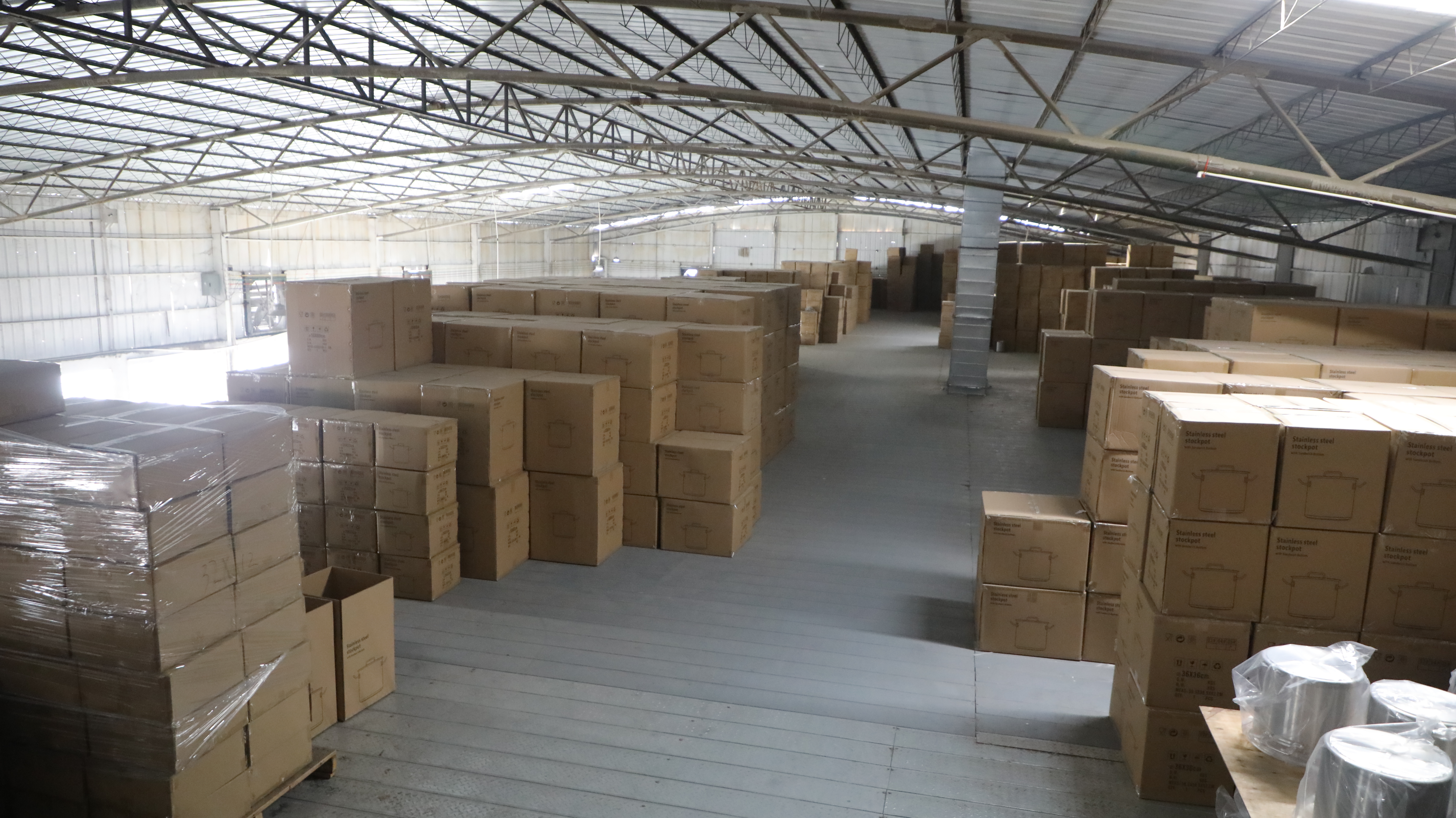
At Jiangmen Vanstar Kitchenware, we have manufactured both construction types since 2018. Our current production covers stock pots, sauce pots, three-layer steel pots, stainless steel dishes and self-service catering equipment, with an annual capacity of about 200,000 pieces. In this guide we set out the engineering differences, the specification fields that actually matter in a purchase order, and a factory audit checklist you can use to verify what a supplier claims.
In this article
- What "three-layer steel" actually means
- How each construction distributes heat
- Stainless grades: 201, 304, 430 and what belongs where
- The specification fields that matter in a PO
- Weight, balance and handling in a commercial kitchen
- Induction compatibility and why the base decides it
- Cost structure: where the money goes
- Failure modes to test for before you commit
- A factory audit checklist for composite-base cookware
- FAQ
What "three-layer steel" actually means
The term is used loosely in the industry, so it is worth pinning down. A composite-bottom or "sandwich bottom" pot is built from a stack of metal sheets bonded together under pressure and heat, then formed into a vessel. The layers are not decoration. Each one does a job.
The three functional layers are:
- The cooking surface — the steel that contacts food, typically a food-grade stainless grade. This layer must resist acid, salt and detergent without pitting or releasing metal ions.
- The conductive core — almost always aluminium, because aluminium conducts heat roughly an order of magnitude better than stainless steel. This is the layer that does the actual heat spreading.
- The base plate — a ferritic stainless steel that is magnetic, so an induction hob can couple to the pot. Ferritic grades are used here because they are magnetic and inexpensive; they are not chosen for corrosion performance.
In practice a "three-layer" composite base is often a five-sheet stack: base plate, aluminium, another base plate, the pot body, and the cooking surface — bonded and rolled so the boundaries disappear. That is why two pots described as "composite bottom" can behave completely differently: the layer count is not the variable, the thickness of the aluminium core is.
The single number to ask for: aluminium core thickness in millimetres. A 2.0 mm core and a 4.0 mm core are both sold as "composite bottom", but the second spreads heat across a 500 mm base far more evenly. Specify it explicitly in your purchase order.
How each construction distributes heat
A single-layer stainless pot has no lateral conduction mechanism. Heat enters only where the flame or the induction coil touches the base. Stainless steel conducts poorly, so the base directly above the burner gets hot while the perimeter stays cooler. The practical result is a hot ring: sauces scorch in the middle, food at the edge cooks unevenly, and the pot needs constant stirring.
A composite base changes the geometry of the problem. The aluminium core takes the concentrated heat input and spreads it sideways before it reaches the cooking surface. The hot spot becomes a hot region, and the temperature gradient across the base narrows considerably.
| Behaviour | Single-layer stainless | Composite / three-layer base |
|---|---|---|
| Lateral heat spreading | Minimal — stainless conducts poorly | Strong — aluminium core spreads heat |
| Temperature variation across base | Wide; pronounced hot ring above burner | Narrower; useful cooking area is larger |
| Scorching risk on low-stir sauces | High | Substantially reduced |
| Response to burner changes | Fast but localised | Slower but even across the base |
| Suitability for long simmering | Workable with constant attention | Better suited to unattended simmering |
| Induction hob compatibility | Only if a magnetic base is fitted separately | Yes, if a ferritic base plate is part of the stack |
There is a real trade-off here that suppliers rarely mention. The aluminium core adds thermal mass, so a composite pot takes longer to reach temperature and longer to cool down. For high-heat wok-style cooking where instant response matters, a thin single-layer vessel can actually feel more responsive. For stock pots holding 20 to 75 litres of liquid at a steady simmer, the composite base wins clearly.
What this means at the capacity level you are buying
Most catering stock pots run from roughly 12 litres up to 75 litres. At the small end of that range, the base diameter is small enough that a single-layer pot is not a serious problem. Above roughly 30 litres, the pot base is wide enough that a single-layer construction will show a visible temperature difference between centre and edge, and that difference will show up as uneven reduction or scorching in the finished dish.
Stainless grades: 201, 304, 430 and what belongs where
Grade selection is where most of the cost difference between quotations comes from, and it is also where buyers most often get an unpleasant surprise. The three grades you will see in cookware quotations are 201, 304 and 430. They are not interchangeable.
| Grade | Type | Where it is normally used | Notes for buyers |
|---|---|---|---|
| 201 | Austenitic | Pot body, lid, basket wire in cost-sensitive lines | Lower nickel content; less corrosion resistance than 304. Acceptable for many dry or short-contact uses, weaker against salt and acid over long exposure. |
| 304 | Austenitic | Cooking surface, food-contact components, premium lines | The default food-grade choice. Strong resistance to acid, salt and detergent. Expect a higher unit price. |
| 430 | Ferritic | Base plate, decorative exteriors | Magnetic, which is why it is used in induction-compatible bases. Not intended as a primary food-contact surface in long-cook applications. |
A very common construction — and one we build — uses 201 for the pot body, lid and base plate, with a 430 base plate and an aluminium core in the composite. That is a legitimate, cost-effective specification for many catering and retail programmes. It becomes a problem only when it is described to the buyer as "304" or when the intended use involves prolonged contact with salted or acidic food.
Verify, do not assume. Ask your supplier for the grade of each layer, not one grade for the whole pot. A "304 cookware" claim that covers only the exterior is technically true and commercially misleading. The material verification method is described in the audit checklist below.
Thickness by component
Thickness is specified per component and is often quoted as a range rather than a single value. Typical figures for commercial stainless cookware sit in the following bands, and it is normal for thickness to increase with pot diameter because a larger unsupported base flexes more.
| Component | Typical thickness | Why it matters |
|---|---|---|
| Pot body | 0.7 – 0.9 mm | Thinner bodies dent more easily under catering handling and warp when cooled rapidly. |
| Lid | 0.7 – 0.9 mm | Very thin lids deform and stop sealing, which costs you steam retention. |
| Base plate (both sheets) | 0.7 – 0.9 mm | The ferritic plates hold the stack together; too thin and the base can delaminate. |
| Aluminium core | 2.3 mm and above | The prime determinant of heat spreading. Specify this explicitly. |
| Total composite base | 3.7 – 3.9 mm typical | Sum of the stack. Larger diameters need the higher figure. |
Note the pattern in the table above: as pot diameter increases from roughly 250 mm to 500 mm, body, lid and base thickness each step up, and the total composite thickness grows with them. If your supplier quotes one uniform thickness across a full diameter range, ask why. That is usually a sign the specification has been simplified for quotation rather than engineered for the range.
The specification fields that matter in a PO
Quotations vary enormously in how much they specify, and vague quotations are the main source of delivery disputes. The fields below are the ones we would expect to see on any serious composite-base cookware purchase order. If a field is missing, it will be filled in by the factory at its own discretion.
| Field | Example value | Why you need it in writing |
|---|---|---|
| Diameter × height | φ300 × H300 mm | Determines nominal capacity and packing. Ambiguity here cascades into carton and pallet errors. |
| Body / lid / base thickness | 0.9 / 0.9 / 0.9 mm | Directly sets weight, rigidity and cost. |
| Aluminium core thickness | 2.3 mm | The performance-defining figure for heat spreading. |
| Total composite thickness | 3.9 mm | The check figure: it should equal the sum of the stack. |
| Material per layer | 201 body & lid, 430 base, 201 basket wire | Prevents grade substitution. |
| Surface treatment | Internal and external sanding, or polished | Affects appearance, cleaning and buyer perception. |
| Handle type and fixing | Riveted wire ear handle, 10 mm | Handle attachment is a common field-failure point. |
| Capacity | 21.20 L / 22.40 QT | Both metric and US customary are usually quoted, because buyers in different markets ask in different units. |
| Packing | Set gross weight, carton size, units per carton | Freight is calculated from this, and errors are expensive. |
| Test/inspection requirement | Incoming and outgoing inspection, sample approval | Ties quality control to a contractual obligation. |
One practical note on units: Chinese factories increasingly quote both litres and US quarts on the same line, because the same pot may be sold into both metric and US markets. Confirm which figure is the nominal design capacity and which is derived, since rounding differences of a few percent are common and become visible when a buyer measures the pot against a printed catalogue.
Weight, balance and handling in a commercial kitchen
Composite construction is heavier. For a hotel kitchen that is usually acceptable and often desirable, because a heavier pot sits more stably on a burner grate and resists being knocked. For retail channels the calculation is different: shipping weight and the customer's perception of the product in the hand both change.
The figures that drive this are the set net weight and the set gross weight, and both should be on the quotation. As a rule of thumb, the composite base contributes a disproportionate share of the total mass because it is the densest part of the stack. When you compare two quotations for the same nominal capacity, comparing set net weight is one of the fastest ways to detect a specification difference that the headline price hides.
| Consideration | Favours single-layer | Favours composite base |
|---|---|---|
| Storage and stacking in a kitchen | — | Heavier pots stack more stably |
| Shipping cost per unit | Lower mass per unit | Higher mass, higher freight |
| Retail hand-feel | Feels light, can read as thin | Feels substantial, supports a premium position |
| Staff fatigue in high-volume prep | Less lifting effort | — |
| Stability on a burner grate | — | Lower centre of gravity, less tipping |
Induction compatibility and why the base decides it
Induction hobs do not heat the pot; they induce a current in a magnetic base and the base heats itself. Austenitic stainless grades such as 201 and 304 are essentially non-magnetic in the annealed condition, so a single-layer 304 pot will often not work on an induction hob at all, however good the pot is otherwise.
This is the second reason for the ferritic base plate. The 430 layer gives the induction field something to couple to. If your sales channel includes any market where induction is common in commercial kitchens or domestic use, "induction compatible" should be an explicit, tested claim on the specification rather than assumed from the word "stainless".
Quick field test for induction compatibility: hold a magnet against the outside of the base. Firm attraction means there is a ferritic layer and the pot will most likely work. No attraction, or only a weak pull, means it will not. This test costs nothing and catches specification errors before shipment.
Cost structure: where the money goes
Buyers often ask why two visually similar pots differ by 30 percent in unit price. The answer is almost never the labour, and almost always the material stack. As a rough allocation for composite-base commercial cookware, the cost breaks down in the following proportions.
| Cost element | Approximate share | What moves it |
|---|---|---|
| Stainless material (body, lid, base) | 40 – 55% | Grade (201 vs 304), thickness, and global nickel prices |
| Aluminium core | 8 – 14% | Core thickness and current aluminium pricing |
| Forming, bonding and finishing labour | 20 – 30% | Surface treatment (sanded vs polished), handle welding, press cycles |
| Packing and consumables | 5 – 10% | Foam, carton grade, individual bagging, custom print |
| Inspection and overhead | 5 – 10% | Incoming/outgoing inspection intensity, tooling amortisation |
The commercial implication is straightforward: price differences between quotations are usually material differences. When a quotation is materially cheaper than the rest, the saving has to come from somewhere in the top two rows — a lower grade, a thinner aluminium core, or both. That is not automatically unacceptable, but it should be a conscious decision backed by a specification you have agreed, not a discovery made after the container arrives.
Failure modes to test for before you commit
Composite-base cookware has a small number of characteristic failure modes. All of them can be detected in the sample stage, which is far cheaper than detecting them in a container.
- Base delamination — the bonded stack separates, producing a visible bulge or a drum sound when tapped. Test by heating and quenching the pot repeatedly, then tapping the base across its full width and listening for a change in tone. A dull or hollow note at the perimeter indicates a bond failure.
- Base warping — the pot rocks on a flat surface after thermal cycling. Place the pot on a surface plate or a granite counter and check for rocking. A composite base that warps will not sit flat on an induction hob, which reduces coupling and performance.
- Handle failure — riveted or welded handles loosen under load. Fill the pot to its working capacity with water and lift it repeatedly by one handle only. This approximates the worst case in a real kitchen and finds weak attachments.
- Pitting and corrosion — appears on lower grades after exposure to salted or acidic contents. Simmer a strong salt solution in the sample for several hours, then inspect the interior. Pitting on the cooking surface indicates the grade is not suitable for the intended use.
- Sharp edges and weld spatter — a handling hazard and a common cause of returns in retail channels. Run a finger along the rim, the handle attachment and the basket wire. Anything that catches or snags needs rework.
A factory audit checklist for composite-base cookware
If you are placing a first order, or moving production to a new supplier, the checklist below covers the points where composite-base manufacturing most often diverges from what was promised. We include it because we would expect a serious buyer to ask us these things.
| # | Check | What good looks like |
|---|---|---|
| 1 | Material certificates for each layer | Grade certificates covering body, lid, base plate and core, not a single blanket document |
| 2 | Incoming material inspection records | Documented inspection of incoming stainless and aluminium, with records rather than verbal assurance |
| 3 | Bonding process under control | Defined pressure, temperature and dwell time for the bonding step, with traceability to production batches |
| 4 | In-process dimensional checks | Diameter, height and composite thickness measured during production, not only at final inspection |
| 5 | Outgoing inspection with records | Final inspection including base flatness, handle load and surface finish, documented and retained |
| 6 | Sample approval loop | Pre-production sample approved against the specification before mass production starts |
| 7 | Weld and joint quality | Handle and ear weld penetration inspected, with a stated acceptance criterion |
| 8 | Export documentation capability | Ability to provide the certificates required for exports to the US and Europe |
| 9 | Capacity evidence | Verified production capacity against your order volume and delivery dates |
| 10 | Corrective action process | A defined route for handling defects found after delivery, not just an apology |
Points 1 through 5 are the ones worth insisting on for a first order. They are cheap to provide if the factory genuinely operates them, and awkward to provide if it does not — which makes them a useful filter.
FAQ
Is a three-layer steel pot always better than a single-layer pot?
No. For wide, high-capacity pots used for simmering and reduction, the composite base is a clear advantage. For thin, small-diameter vessels where fast response matters more than evenness, a single-layer pot can perform perfectly well and cost less. The right answer depends on the cooking task, not on the layer count.
Can a 201 stainless pot be food-safe?
Yes, for many applications. 201 is a legitimate stainless grade widely used in cost-sensitive cookware. The constraint is corrosion performance: 201 has less nickel than 304 and is more vulnerable to attack from salt and acid over prolonged contact. For short-contact, neutral-pH cooking it is entirely serviceable. For long simmers of salted or acidic food, 304 on the cooking surface is the safer specification.
How do I confirm the aluminium core thickness without cutting the pot?
Ask for the thickness as a specification line together with the total composite thickness, then verify the total by measuring the base edge with a caliper at several points. The total should match the sum of the declared layers. If the declared total and the measured total disagree, the discrepancy is usually in the core.
What capacity range should I specify for a hotel kitchen?
Most hotel and catering operations cover a range rather than a single size, typically from around 12 litres for sauce work up to 50 to 75 litres for stocks and large-batch preparation. Specifying a range rather than one size usually produces better freight economics, because the pots nest and share carton dimensions.
Do you provide certificates for exports to the US and Europe?
Yes. We can provide certificates for exports to the US and Europe, and we offer integrated design and production with customisation based on customer requirements and samples. Documentation requirements vary by market and product line, so the practical approach is to tell us your destination market and let us confirm which certificates apply before the order is placed.
Sourcing composite-base cookware for a catering or retail programme?
Send us your specification — diameters, capacities, intended market and any induction requirement — and we will confirm the material stack, layer thicknesses and the certificates available for your destination market. We manufacture in Jiangmen, Guangdong, with an annual capacity of about 200,000 pieces.
Related reading
This guide covers the engineering behind the base. If you want the commercial side — how a custom cookware programme runs from drawing to container — the next article in this series walks through the full project sequence.